 colow ismail
 Playing victim in Hargeisa and power broker in Mogadishu how the same narrative sustains both
In the high-stakes theater of Somali politics, few narratives are as meticulously guarded as somaliland’s “politics of victimhood.” It is a narrative that serves as the moral and legal foundation for Isaaq’s secession, casting the Federal Government of Somalia (FGS) as the perennial antagonist a direct successor to the military regime that committed atrocities against the people of the north and the rest of the country in the 1980s.
However, a cold audit of the current political landscape reveals a glaring contradiction that the ruling elite in Hargeisa find increasingly difficult to reconcile: the very people whose identity is defined by this “victimhood” are simultaneously the architects, ministers, and legislators of the same Federal Government they publicly disavow.
The Paradox of Participation
Across multiple administrations, Isaaq elites have held representation in parliament, ministerial roles, and diplomatic appointments. This presence coexists with a political narrative insisting on total separation, creating a visible tension between rhetoric and practice.
The common rhetoric suggests somaliland exists in a political vacuum, separate and distinct from the south. Yet the halls of Villa Somalia and the chambers of the Federal Parliament tell a story. Isaaq, the primary clan base of the somaliland narrative, hold high-ranking ministerial portfolios, significant parliamentary blocs, and influential senate seats within the federal government.
If the FGS truly represented a genocidal continuation, this engagement would be a betrayal. Instead, it is a silent, parallel track. This participation reveals that Isaaq elites are not outsiders, but insiders holding seats at two tables. By publicly rejecting a state they privately harvest, the leadership maintains a dual-market leverage. This is not principled distance; it is a pragmatic exploitation of the very system they condemn, proving that for the elite, the boundary is a tool, not a barrier.
This dual presence does create overlapping incentives that complicate the narrative of total separation. It introduces a structural ambiguity that allows engagement and rejection to coexist without resolution.
Victimhood as a Political Asset
To understand this contradiction, victimhood must be viewed not as collective trauma, but as a negotiable political asset. In Hargeisa, victimhood is the primary currency used to consolidate domestic power. It manufactures a permanent “siege mentality” that allows the Isaaq elites to bypass internal critiques of governance, corruption. This narrative functions as an absolute shield: to question the administration is to desecrate the “struggle” itself.
In Mogadishu, the same identity is repurposed as leverage within the 4.5 power-sharing system. Here, historical grievance is weaponized to extract “compensatory” political rents. The elites argue that past suffering entitles the clan to a disproportionate share of federal power, international aid, and diplomatic representation.
Over time, when a political narrative consistently produces tangible returns power, access, legitimacy it begins to operate less as memory and more as a system of incentives.
Stealth Authoritarianism
This system persists through active maintenance and strategic ambiguity. By refusing to define its relationship with the FGS avoiding both integration and disengagement the leadership prevents institutional collapse. Here, ambiguity is not confusion; it is deliberate policy.
Security actors enforce internal boundaries, substituting force for consent in resistant peripheries. This coercion is then rhetorically reframed as “protection” to maintain a veneer of stability. Economic closure benefits business elites, who prefer restricted competition over free market. Meanwhile, diaspora and media networks export this curated narrative, securing external legitimacy while shielding internal inequalities.
Crucially, the system’s strength lies in what does not happen. While internal dissent is rampant, it is neutralized by a high “cost of deviation.” By rewarding alignment and punishing dissent, the system ensures that opposition remains atomized and unable to trigger collective change.
The Strategic Anachronism
The greatest threat to this dual-market strategy is the acknowledgment of change. The current Federal Government, established in 2012, is a decentralized, inclusive entity sharing nothing with the military junta but the name of its capital. It was built specifically to prevent the return of dictatorship. By refusing to distinguish between Siad Barre’s regime and today’s federal framework, the northern elite maintain a Strategic Anachronism.
They must keep the ghost of the Siad Barre alive; if the ghost dies, the justification for their exclusive power dies with it. If the FGS is recognized as a legitimate, reforming partner, the “existential threat” narrative collapses. This would destroy the emotional leverage used to keep the population in a state of perpetual mobilization, exposing the system’s internal failures.
The Death of Emotional Leverage
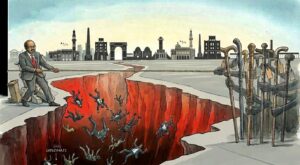
You cannot mobilize a hungry population indefinitely with the stories of those who came before. As the “existential threat” narrative loses its teeth, the elite are forced to move from persuasion to coercion. This shift where force substitutes for consent is the beginning of the end for a system built on victimhood capital.
The Bottom Line: The elites are playing a game of Strategic Anachronism, but the youth are living in Real-Time Necessity. When the business model of the past can no longer buy the peace of the future, the wall is reached.
Conclusion: A System That Cannot Resolve Itself
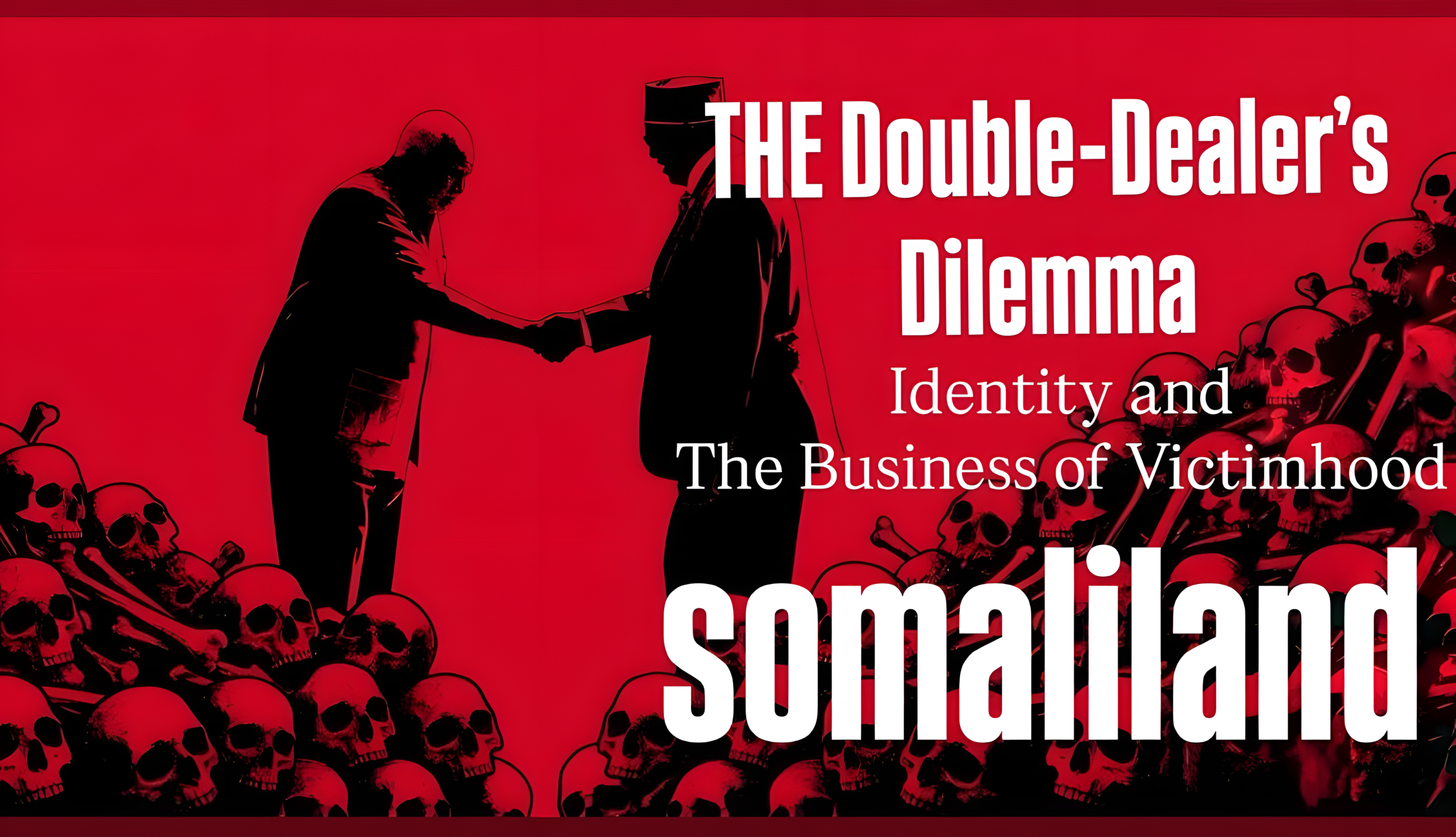
The “double-dealer” model thrives only in the shadows of its own contradictions. This suspension publicly rigid yet privately flexible is not a sign of resilience; it is a structural trap. Integration would dissolve the hierarchy of victimhood. Consequently, the system is paralyzed by its own design.
A political order built on hypocrisy cannot evolve; it can only persist until its foundations buckle, it has become a hostage to its own incentives. The narrative of historical grievance, once a tool for survival, has been commodified into a mechanism for closure and rent-seeking. The reality is now inescapable: Victimhood is no longer just a story of Isaaq. It is a business model and every bad business model eventually hits the wall.