 colow ismail
 How a history of shared suffering is being recast into a political narrative to legitimize secession
The collapse of the Somali state in 1991 followed more than two decades of authoritarian rule marked by repression, violence, and widespread human suffering. In the final years of the regime, communities across the country experienced displacement, detention, and loss, reshaping entire societies. Somalia’s tragedy was national in scope and evenly distributed across time and geography.
The Marxist regime maintained power through a systematic “scorched earth” policy, turning urban centers into killing fields. Following a 1978 coup attempt, the elite Red Berets devastated Galkayo, destroying over 50 water reservoirs and slaughtering livestock triggering a localized famine alongside thousands of executions. This pattern of state-sponsored terror extended to Beledweyne in 1982, which was bombed to warn that the Somali Air Force would strike any city harboring opposition.
By 1988, this violence reached the northern cities, where the regime launched a relentless campaign keeping his promise, Burao and Hargeisa were aerially bombed after insurgents entered the cities. While these brutal operations claimed the lives of tens of thousands of civilians, the scale of death remained far lower than the tragedy that would soon follow in the south.
By July 1989, the brutality reached Mogadishu during the Jazeera Beach Massacre, where 180 men were rounded up at random and executed on the coast. As the regime began to collapse, “mopping up” operations in Kismayo led to mass killings and displacement throughout the Juba regions. However, the most insidious punishment occurred in Baidoa, where a genocide by attrition took place. The regime’s soldiers engineered a famine by looting and destroying farms and killing livestock; this “City of Death” ultimately claimed the lives of 300,000 to 500,000 people, becoming the deadliest chapter of the state’s collapse.
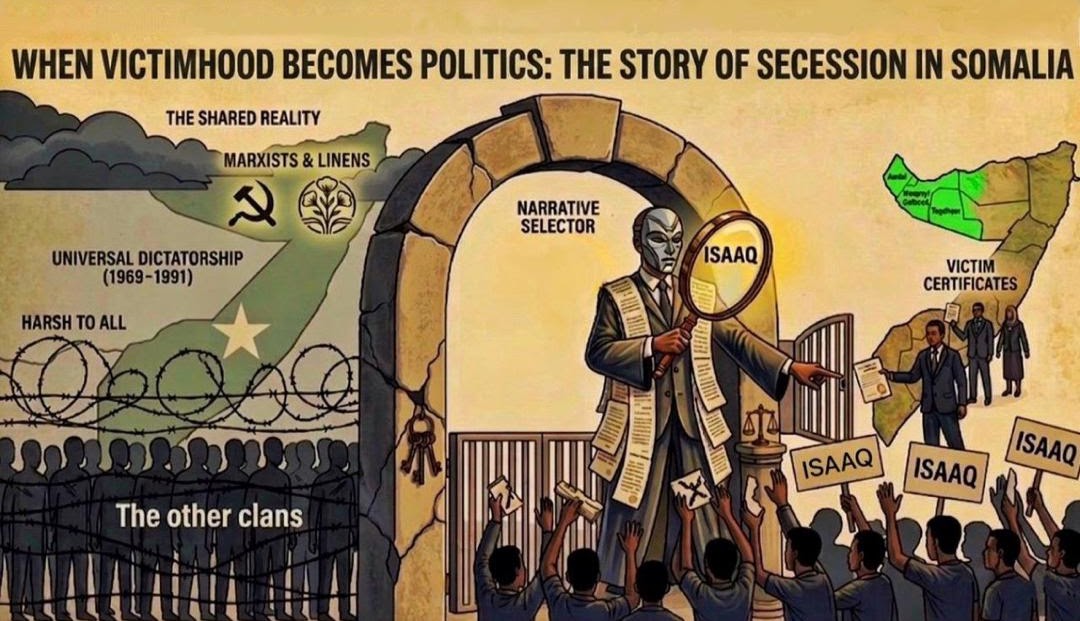
Yet over time, this complex history has increasingly been distilled into narrower political narratives. Certain clan experiences of violence have come to occupy a central place in public memory and state-building discourse, while others remain less visible in both domestic and international accounts. This process has significant political consequences: victimhood, once a broadly shared historical condition, has become a form of political capital used to justify present-day claims and shape external perceptions.
Curating Memory, Consolidating Power
The construction of national identity in somaliland is an active political project shaped by selective memory, institutional reinforcement, and reprisal against dissent. While the violence of the Marxist regime is a well-documented reality across Somalia, its contemporary deployment in official narratives serves to mobilize history for political legitimacy. This dominant story, centered on victimhood and a moral rupture from Somalia, functions as a curated framework that privileges specific clans’ interpretation while marginalizing others.
This selective framing is most visible in the education system, where history is codified into simplified, linear forms. By emphasizing Isaaq’s singular account of past regime violence, the curriculum narrows the interpretive space for students and reinforces indoctrination. Internal divisions and alternative perspectives are suppressed, producing a history that is coherent but incomplete. Such pedagogy legitimizes a contested political status by embedding it within an unquestioned historical logic.
Normalization occurs through repetition across media, education, and public discourse. Core themes of external threats and historical grievances eventually operate as “common sense,” shaping public perception in powerful ways.
This is reinforced by the regulation of symbolic expression; for example, the prohibition of the Somali flag delineates clear boundaries around political identity, actively constraining the range of permissible political imaginaries. Social dynamics further sustain these boundaries.
In interconnected communities, the fear of imprisonment encourages self-censorship, creating a public consensus that may not reflect private beliefs. Simultaneously, somaliland presents an outward-facing image of democratic stability and pluralism to attract international support for its secession.
The Architecture of Submission: From Borama to Las` Anod
In the early climate of secession, it was strategically imperative to establish a unified front at any cost. According to Imam Sheikh Hassan Deheeye’s account of the events in Dila and Borama on February 4, 1991, Muse Bihi assisted by Ethiopian soldiers and clan affiliates Col. Abdillahi Darwal and Boobe Yusuf Duale opened fire on civilians, resulting in thousands killed and wounded to force the Samaroon clan into submission. To this day, people remain missing in unmarked mass graves outside the city and near the Ethiopian border
This was not an isolated incident of revolutionary chaos, but a blueprint for hegemony. Later the military campaign turned east. Muse Bihi’s forces initiated a six-month campaign of heavy artillery bombardment, destroying mosques and hospitals and displacing nearly 200,000 families in a brutal effort to subdue the Dhulbahante clan.
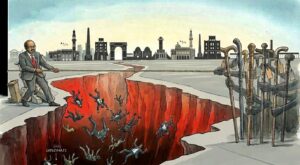
The historical irony is as bitter as it is revealing. The same figures who orchestrated the bloody submission of Borama in 1991 presided over the shelling of Las`Anod in 2023. This continuity of violence strips away the thin veneer of democratic “exceptionalism” that somaliland projects to the world. It suggests that the “liberation” narrative was never about escaping a dictator’s reach, but about replacing a national dictatorship with a localized clan hegemony. A clear signal that in this state-building project, victimhood is a privilege reserved for isaaq, while submission is a requirement for the rest.
The Risk of Weaponizing History
Ultimately, the coexistence of this official narrative with restrictive internal practices exposes a significant tension. A system relying on controlled narratives and constrained expression may achieve short-term cohesion, but it risks undermining its own claims to democratic legitimacy.
The fundamental challenge for Somalia is not whether history matters-it clearly does. Rather, the challenge lies in its application. If history remains a fixed tool for division, it will continue to stall the development of inclusive political solutions. However, if these diverse experiences are integrated into a balanced national narrative, they can transform from a source of conflict into the foundation for a more stable and cooperative future.