 amiin ahmed
 To build a state, Somalia must retire clan elders from politics
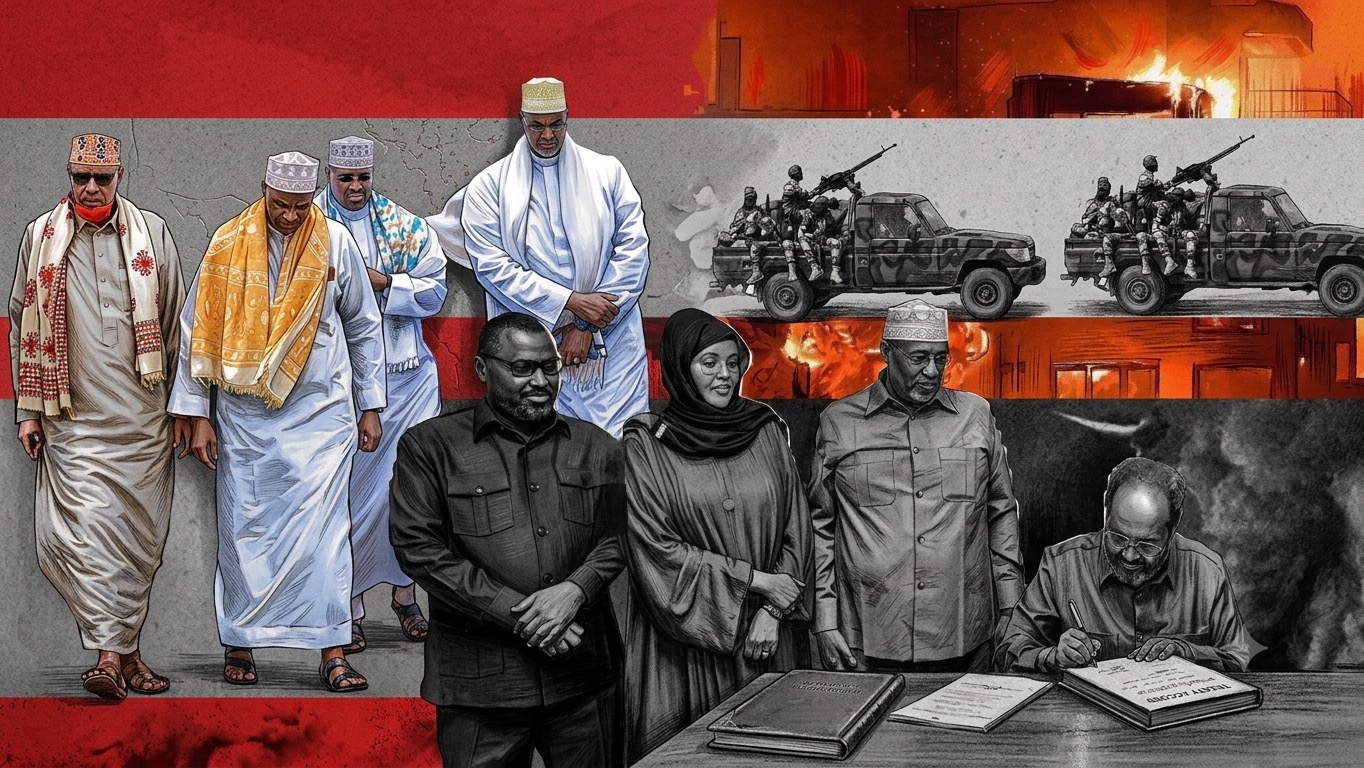
Last week, Mogadishu offered the world yet another glimpse of Somalia’s permanent purgatory. Parliament voted to amend the constitution: dual citizens would be barred from high office, elections would move toward one-person-one-vote, and the government’s term would extend from four years to five. As political tensions over those changes escalated, some opposition leaders holding foreign citizenship mobilized against it. Hassan Ali Khaire, a former prime minister and Norwegian citizen, assembled clan militia at the residence of a member of parliament from his clan, himself a former warlord, with the backing of his clan leader. A two-day armed standoff followed. It ended not with an arrest, a court order, or a police operation, but with the head of the National Intelligence and Security Agency personally guaranteeing the former prime minister’s safety. He returned home. The guns fell silent.
The ceasefire may survive for weeks or months, but the constitutional dispute remains exactly where it stood before the first fighter mobilized. The next politician who finds himself similarly excluded will simply reach for the same playbook. The government, rattled by the confrontation, declared that henceforth no one but the state may bear arms.
If this sequence feels familiar, it is because it has become the rhythm of Somali political life. A dispute erupts. Militias mobilize, often along clan lines. Elders intervene and negotiate a stand-down. Violence pauses, but the underlying fracture whether constitutional, political, or territorial remains unresolved. Months or years later, a new trigger reproduces the same drama. Somalia has built a political order that repeatedly contains conflict without ever settling it. At the heart of that order sit the clan elders: unelected, lineage-based arbiters whose talent for securing tactical ceasefires has become one of the greatest obstacles to state-building.
Every society has informal leaders who calm tempers in family disputes or broker reconciliations between competing interests. The problem is that, since the Arta peace process of 2000, Somalia has embedded elders directly into the machinery of formal governance.
Clan elders were elevated because no other source of legitimacy remained. What was intended as a temporary bridge from statelessness to government gradually became part of the government itself. The 4.5 power-sharing formula distributes parliamentary seats according to clan affiliation, while elders retain substantial influence over candidate selection. They shape parliamentary composition, influence cabinet formation, and convert traditional prestige into political power.
After almost three decades, however, pragmatism has become an alibi for stagnation. The elder system does not merely manage conflict; it benefits from its persistence. Elders derive prestige and relevance precisely because the state remains too weak to adjudicate disputes or provide security. Why settle a political dispute conclusively through law when mediation preserves influence and access? The incentive is not to extinguish the embers but to keep them glowing at a manageable temperature.
Clan elders exercise public authority without producing public law. Political entrepreneurs seeking power must first negotiate with elders, meaning the route to influence runs not through citizens with ideas but through clan gatekeepers.
Courts issue written judgments. Legislatures enact statutes. Constitutions establish rules. These become precedent and create expectations that outlive the people who authored them. Elder settlements do not. They remain largely oral understandings enforced through social pressure rather than legal authority. They may end a dispute today, but they rarely prevent its return tomorrow. Governing a state is fundamentally different from managing a society.
Somalia has become exceptionally adept at preventing disputes from spiraling out of control while remaining remarkably ineffective at resolving them permanently. Every crisis becomes a fresh negotiation because previous bargains leave behind no binding legal record, no enforceable precedent, and no institution capable of compelling compliance.
The opposition’s rallying cry today “elections must be held as they were before” is a masterwork of irony. Many of the same figures now defending the delegate-based system once campaigned on promises of one-person-one-vote elections and constitutional completion. Their sudden attachment to the status quo reveals a simpler truth: the 4.5 formula, combined with vote-buying and elite bargaining, has become a comfortable incumbency-protection mechanism for those who understand how to navigate it. Direct elections threaten not merely individual careers but an entire ecosystem of political brokerage built around elders as gatekeepers of representation.
The argument therefore extends beyond electoral reform. A republic cannot be governed indefinitely through unwritten authority. Every successful state rests upon rules that survive the people who create them. Constitutions endure after presidents retire. Court judgments bind future cases. Oral settlements do not. A system that relies on memory, reputation, and lineage will inevitably struggle to provide the predictability that citizens, businesses, and investors require.
President Hassan Sheikh Mohamud is attempting to deliver reforms that many of his predecessors and rivals once promised, however late and imperfectly. His principal mistake was one of sequencing and timing. A constitutional transformation of this magnitude, launched in the latter stages of a presidential term, will inevitably be viewed as a power grab, even when parts of its substance are defensible.
Yet the opposition’s willingness to mobilize clan muscle against the process ultimately reinforces the reform’s central premise. Somalia cannot become a modern state so long as the final arbiter in politics remains the gun and the elder capable of summoning it.
Other societies have navigated similar transitions. In medieval Europe, local lords dispensed justice and exercised authority through personal loyalty rather than institutions. Their influence declined not because they were outlawed, but because courts, bureaucracies, and standing armies gradually outperformed them. Tradition receded when institutions became more reliable than lineage. In parts of post-colonial Asia, governments expanded courts, land registries, and local administration until citizens increasingly preferred formal systems to tribal mediation. Informal authority survived, but political authority moved elsewhere.
Somalia must adopt a similar logic. The task is not to outlaw clan elders directly that would be both futile and dangerous but to make them institutionally redundant, one function at a time.
First, build a judiciary that is genuinely more attractive than the elder’s circle. This does not require a supreme court capable of resolving every constitutional controversy overnight. It requires local courts capable of settling political, land, and commercial disputes quickly, fairly, and predictably.
Second, security. Somalia needs police and local security institutions whose legitimacy derives from law rather than clan affiliation. When citizens trust a police officer more than an armed cousin, the foundations of elder authority begin to erode.
Third, reform representation from the ground up. Direct and credible local elections would gradually produce politicians whose mandate flows from voters rather than lineage networks, as demonstrated by the local elections recently held in Mogadishu. A constitutional sunset clause on the 4.5 formula would force the political class to begin building genuine constituencies instead of relying on traditional gatekeepers.
Clan elders will remain important social figures, much as hereditary peers and religious leaders do in mature democracies. They can advise, mediate, and preserve social cohesion. But the moment they determine who enters parliament, shape constitutional outcomes, or decide whether a political actor can be held accountable, Somalia ceases to be a state in the making and becomes a permanent negotiation conducted inside a structure that merely resembles one.
The choice is not between clan elders and chaos. It is between unwritten authority and written authority; between temporary settlements and durable rules; between a political order that depends on personalities and one that depends on institutions.
Should a nation of millions be held hostage to the demands and threats of a handful of political actors and the clan leaders who underwrite them? That is the question last week’s ceasefire, like so many before it, leaves unanswered.
Somalia’s future depends on whether it finally dares to answer it.