 amiin ahmed
 Obey the brokers, or risk collapse
Somali politics has always had a talent for hiding ugly realities beneath respectable language. No word hides more dysfunction than “consensus.” In theory, it suggests wisdom, restraint, and political maturity. In practice, it has become something else entirely: a lock on change.
Inside the fortified corridors of Mogadishu and every big city, “consensus” no longer means agreement. It means permission. Nothing moves unless the men who profit from paralysis approve of it first.
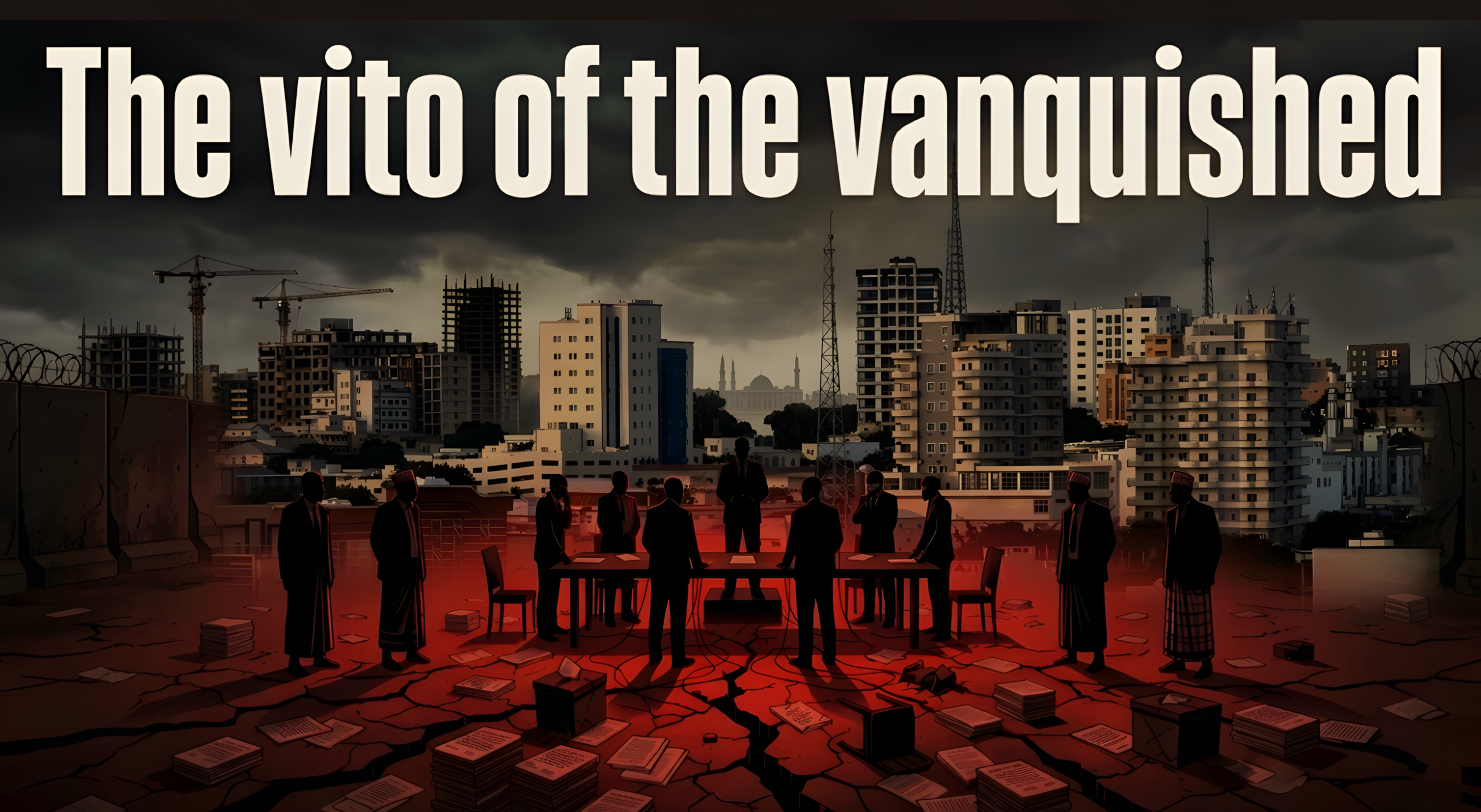
This is the real architecture of the Somali political order. A system where every actor possesses enough leverage to obstruct, but not enough legitimacy to settle anything permanently. The result is a country trapped in permanent negotiation, ruled less by law than by managed stalemate.
A political order where the losers of history, the veterans of collapse, and the brokers of instability continue to sit at the center of national life, using the language of stability to ensure that nothing ever truly stabilizes.
The Business Model of Fear
Every election season in Somalia follows the same script. Pressure rises, political tensions deepen, and suddenly the ghosts of 1991 begin walking through every conversation again.
The warning always arrives wrapped in patriotic language: move too fast, push too hard, ignore “consensus,” and the country will return to collapse.
The civil war is no longer treated as a tragedy to overcome. It is treated as political capital. A memory to be activated whenever the old order feels cornered.
The public is taught to fear instability so deeply that even the men most responsible for preserving instability can present themselves as guardians against it.
The irony borders on parody. Many of the loudest voices warning Somalia about chaos built their careers inside chaos. They survived because the state failed. They accumulated leverage because institutions remained weak. They became indispensable precisely because Somalia never fully escaped transition.
For this class, a functioning state is not simply inconvenient. It is existentially dangerous.
A state with clear rules, enforceable authority, and predictable political succession has little use for middlemen. It does not require political brokers to endlessly mediate between crisis and temporary compromise. It does not reward men whose only skill is turning national fragility into personal leverage.
Consensus as a Weapon
In functioning political systems, consensus exists to reduce fear. It is supposed to reassure minorities while allowing institutions to move forward. In Somalia, however, the concept has been inverted.
Consensus has become the mechanism through which paralysis acquires moral legitimacy.
The language sounds democratic, but the structure is feudal. “Broad agreement” rarely means public participation. It means elite approval. It means every faction with enough disruptive capacity must first be compensated before the state can proceed with even basic decisions.
There are conferences without conclusions. Summits without settlement. Agreements that immediately collapse into renegotiation. Committees that produce roadmaps toward other committees. Entire governments spend years administering process instead of authority.
The state performs governance without governing.
Nothing illustrates this better than the way political disputes are handled. No issue is ever fully settled because settlement itself threatens the leverage economy. If rules become final, someone loses bargaining power. If institutions become predictable, someone becomes irrelevant.
And irrelevance is the one thing Somalia’s political class fears more than instability itself.
The International Financing of Paralysis
The veto state survives not only because Somali elites protect it, but because foreign actors subsidize it. For decades, external partners have approached Somalia with one overriding obsession: avoiding collapse. That fear has produced an entire diplomatic culture built around risk management rather than state formation.
As a result, foreign actors constantly reward obstruction in the name of “inclusivity.”
Every time a spoiler blocks a process and diplomats rush to demand “dialogue,” the lesson becomes clearer. Delay works. Crisis works. Escalation works. The fastest way to gain relevance in Somalia is not to build institutions, but to threaten their disruption.
The international system “unintentionally” transformed political obstruction into a profitable profession.
A regional actor threatens boycott? More negotiations.
A faction rejects an agreement? More concessions.
An election stalls? Another “consultative forum.”
The message absorbed by the political class is devastatingly simple: the state cannot move unless every broker is paid.
Somalia possesses the language of sovereignty without the sovereignty of decision-making. It has ministries, strategies, roadmaps, and summits, yet almost every major national question remains hostage to bargaining among competing networks of leverage.
Meanwhile, the citizen sits outside the compound walls watching an endless performance staged in the name of “stability.”
The Broker vs. The Citizen
At the center of today’s political struggle lies a deeper conflict rarely stated openly: the struggle between the broker and the citizen.
This is why the debate over one-person-one-vote terrifies so much of the political class.
The resistance is not primarily technical. Somalia’s elites navigate infinitely more complex financial, military, and security arrangements every year.
Direct suffrage threatens the broker state itself.
Under the current system, power flows through controlled channels: clan caucuses, elite negotiations, indirect selection mechanisms, and private bargaining circles. This structure rewards intermediaries-men who claim to speak for entire constituencies while remaining accountable only to themselves.
It shifts legitimacy away from negotiated access and toward numerical consent. It reduces the value of the political middleman. It threatens the men whose entire relevance depends on controlling the distance between the public and the state.
The demand for endless consultation is often less about national cohesion than elite survival. Delay becomes strategy. Ambiguity becomes protection. Process becomes warfare by other means.
Because once rules become real, some careers end.
The State Without Finality
Somalia’s deepest political crisis is not merely corruption, clan rivalry, or weak institutions. It is the absence of finality.
Nothing ever fully concludes.
The state announces decisions, but nobody experiences them as final authority. Laws exist, but their enforcement depends on negotiation. Institutions function, but only within invisible limits enforced by political leverage.
The country exists inside a system of managed ambiguity where everyone retains enough power to block outcomes, but nobody possesses enough legitimacy to impose them conclusively.
And so Somalia remains trapped in the logic of the unfinished transition.
Beyond the Veto State
The fear of collapse has kept Somalia psychologically hostage allowing every political crisis to be framed as a choice between paralysis and catastrophe.
But no country can build a future while permanently negotiating with the fear of its past.
At some point, legitimacy must come from rules instead of intimidation. Institutions must acquire authority beyond elite moods. Political actors must learn to lose without threatening national collapse.
Otherwise Somalia will continue drifting through the same cycle endlessly: fear, bargaining, obstruction, temporary compromise, and renewed crisis.
The language will remain sophisticated. The conferences will remain crowded. The communiqués will remain polished.
But beneath the polished language and endless demands, the Somali state will remain exactly where it has been for decades: trapped inside a system where every actor can veto the future, and nobody can build one.