 colow ismail
 How a Temporary Monetary Emergency Hardened Into a Governing Arrangement
In the market, a money changer counts the notes, holding each 1,000-shilling bill against the sun, checking for counterfeits and wear. By his own estimate, ninety-eight out of every hundred notes in circulation are fake or badly degraded. Vendors increasingly refuse them. Even the minibuses, once the last refuge of cash, now rely on mobile payments denominated in dollars. The currency is disappearing first in the very places where it should be most alive, while the institution charged with defending it speaks with far more confidence about everything else.
That is how a dollarized republic begins: not with a formal declaration, but with a quiet rearrangement of daily life. A state can preserve the symbols of monetary sovereignty long after it has lost the practical command that gives those symbols meaning.
The Central Bank of Somalia has not merely failed to restore the Somali shilling. It has adapted to a political and economic order in which the absence of a national currency imposes fewer costs than its restoration. That adaptation is visible in the Bank’s operational logic, its governance structure, its symbolic participation in continental systems, and the broader political economy that rewards delay.
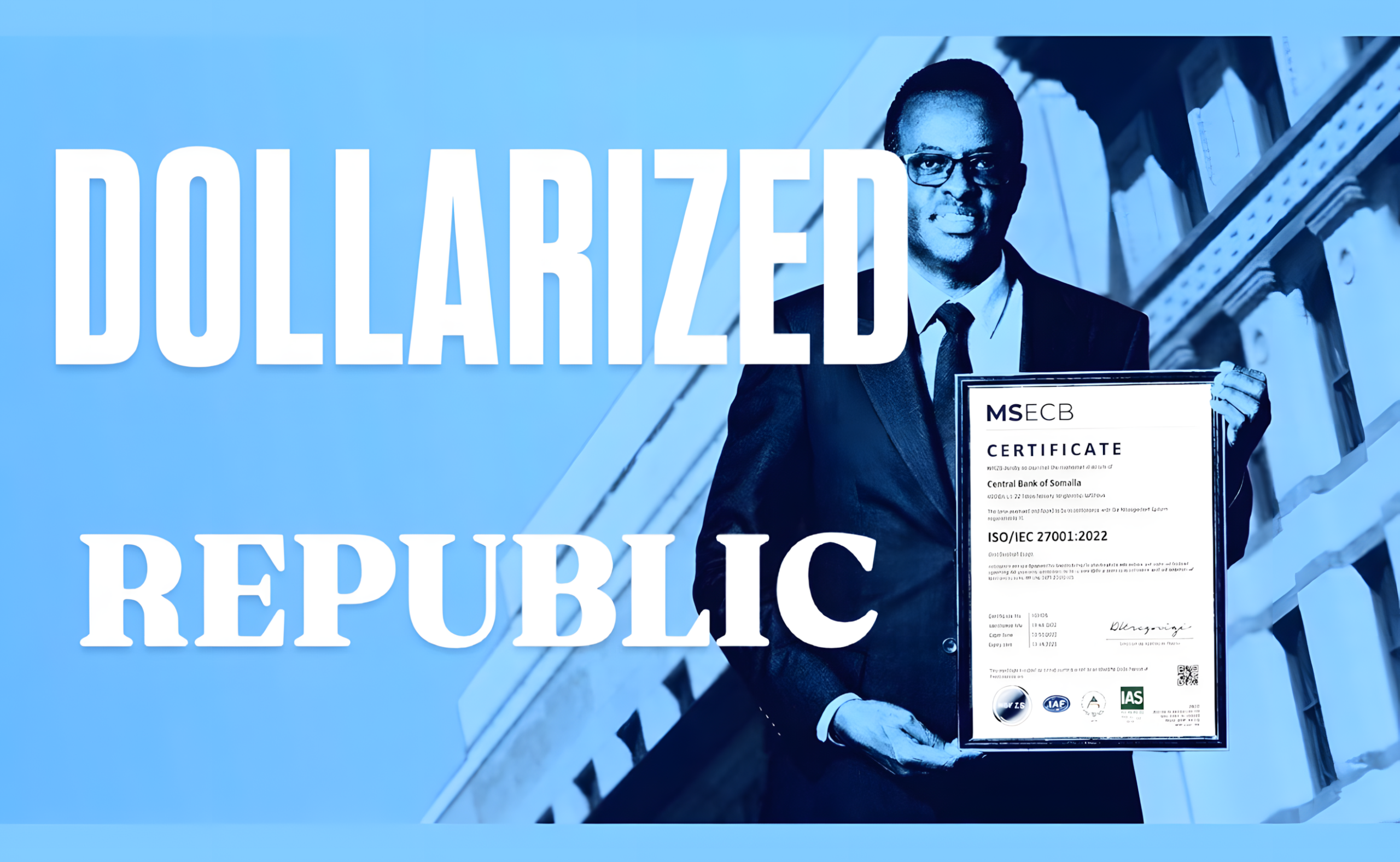
After state collapse, dollarization filled a monetary vacuum. What began as survival gradually hardened into governing arrangement. Today, the Bank oversees a dollarized and increasingly digital financial system with real sophistication, yet it has not rebuilt the one institution that gives a central bank its purpose: a functioning national currency.
A sovereign currency imposes obligations. It requires a central bank to issue notes, defend credibility, manage supply, confront inflation, and maintain public confidence. Dollarization removes those burdens. Stability is effectively outsourced, while the political costs of monetary management are deferred.
The result is a system in which the Bank can supervise transactions, regulate payment networks, publish strategic frameworks, and coordinate with international partners without confronting the harder challenge of rebuilding monetary authority itself. It can administer the system without being forced to restore the thing that makes the system sovereign.
In 2011, Somali banknotes reportedly worth $49 million were printed and stored in Sudan. The former governor publicly acknowledged their existence in 2021. Since then, conflict has engulfed Khartoum, yet there has been little public accounting of the notes’ status, viability, or possible role in currency reform. A central bank treating restoration as an urgent strategic objective would have made those questions impossible to ignore. Silence, in this context, is not neutral. It is part of the architecture of delay.
Governing dollars is easier than governing shilling.
Governance Without Friction
Institutions rarely reform themselves when the costs of inaction are lower than the costs of change. That is where the Bank’s governance structure becomes central to the argument. Authority remains concentrated. The same leadership circle occupies both strategic and executive space. Operational and supervisory functions sit too close together. Such arrangements may create procedural continuity, but they also reduce the internal friction that forces institutions to confront unresolved failures.
The currency project cannot remain indefinitely suspended in the language of readiness. At some point, restoration must move from aspiration to obligation. Yet the current structure allows the institution to discuss preparedness, publish frameworks, and pursue modernization initiatives without being compelled to answer a more fundamental question: why has the national currency remained outside the center of economic life for so long?
Without internal reform, there is no force that restarts what the Bank has stopped doing.
The contradiction becomes even clearer in the Bank’s approach to international integration. The Pan-African Payment and Settlement System PAPSS was designed to facilitate trade in African currencies and reduce dependence on external reserve currencies. For states with functioning monetary systems, participation extends sovereignty. It increases the reach and utility of national currencies beyond domestic borders.
For Somalia, the relationship is more complicated. The country enters a framework built around sovereign currencies while lacking a fully functional sovereign currency at home. The system may improve efficiency and continental connectivity, but it does not solve the underlying problem of monetary dependence. It enhances visibility without restoring capacity.
This is the modernization trap. The Bank becomes more compliant, more connected, and more legible within international financial networks, while the question of currency restoration moves further into the background. Integration begins to substitute for reconstruction. The Bank gains the appearance of sovereignty without paying sovereignty’s most difficult costs.
The persistence of dollarization cannot be explained by institutional caution alone. The current arrangement produces beneficiaries. Importers avoid exchange-rate uncertainty. Financial intermediaries benefit from dollar liquidity. Political actors operate without the constraints that a sovereign currency can impose on fiscal behavior. International partners engage a system that aligns with their preferences for predictability, compliance, and stability.
Restoring the shilling would disturb that equilibrium. It would require difficult decisions about money supply, reserves, distribution, credibility, and enforcement. The benefits would be long term and widely distributed. The costs would be immediate and concentrated among actors with influence.
That is why delay persists. Not because the obstacles are unknown, but because the existing arrangement remains politically and economically tolerable for too many stakeholders.
What emerges from these dynamics is not a failed central bank, but an institution increasingly optimized for a system in which monetary sovereignty is absent. Operationally, the Bank functions. But each adaptation that makes dollarization easier also weakens the urgency of restoring the shilling itself.
The contradiction is that success within the current model reinforces dependence on that model. The more effectively the Bank manages a dollarized economy, the less pressure it faces to rebuild a sovereign monetary one.
The long-term cost extends beyond seigniorage or policy flexibility. States exercise authority through laws and institutions, but also through money. When a national currency ceases to organize economic life, sovereignty becomes administrative rather than monetary. The danger is not sudden collapse. It is normalization: the gradual acceptance of a system in which the symbols of monetary authority remain while its substance recedes.
The final question is not whether the Central Bank can restore the shilling. It is whether an institution that has learned to function without its own currency is still a central bank at all.