
 colow ismail
 How the CBS Managed the Shilling into Extinction
The restoration of the Somali Shilling (SOS) was supposed to mark the final phase of Somalia’s return to economic sovereignty. After decades of collapse, the reintroduction of a national currency would signal something fundamental: that the state had regained control over its own monetary system. That moment has not arrived. Instead, something quieter and more consequential is taking place. This is no longer a question of historical legacy. It is a failure of action.
The origins of the crisis are well understood. When the Central Bank of Somalia (CBS) collapsed in 1991, so did monetary authority. Currency supply froze. No new banknotes were issued, and over time all denominations except the 1,000-shilling Somali note disappeared. What remained deteriorated physically, while counterfeiting filled the gap. By IMF estimates, up to 98 percent of the notes in circulation are fake.
But history explains the problem. It does not excuse the present.
For years, the CBS has acknowledged the collapse of the currency without resolving it. It has produced strategies, frameworks, and reform plans. It has engaged international partners and outlined pathways toward currency reform. Yet it has failed to perform its most basic function: issuing and maintaining a national currency.
A central bank that does not issue currency is not incomplete. It is failing.
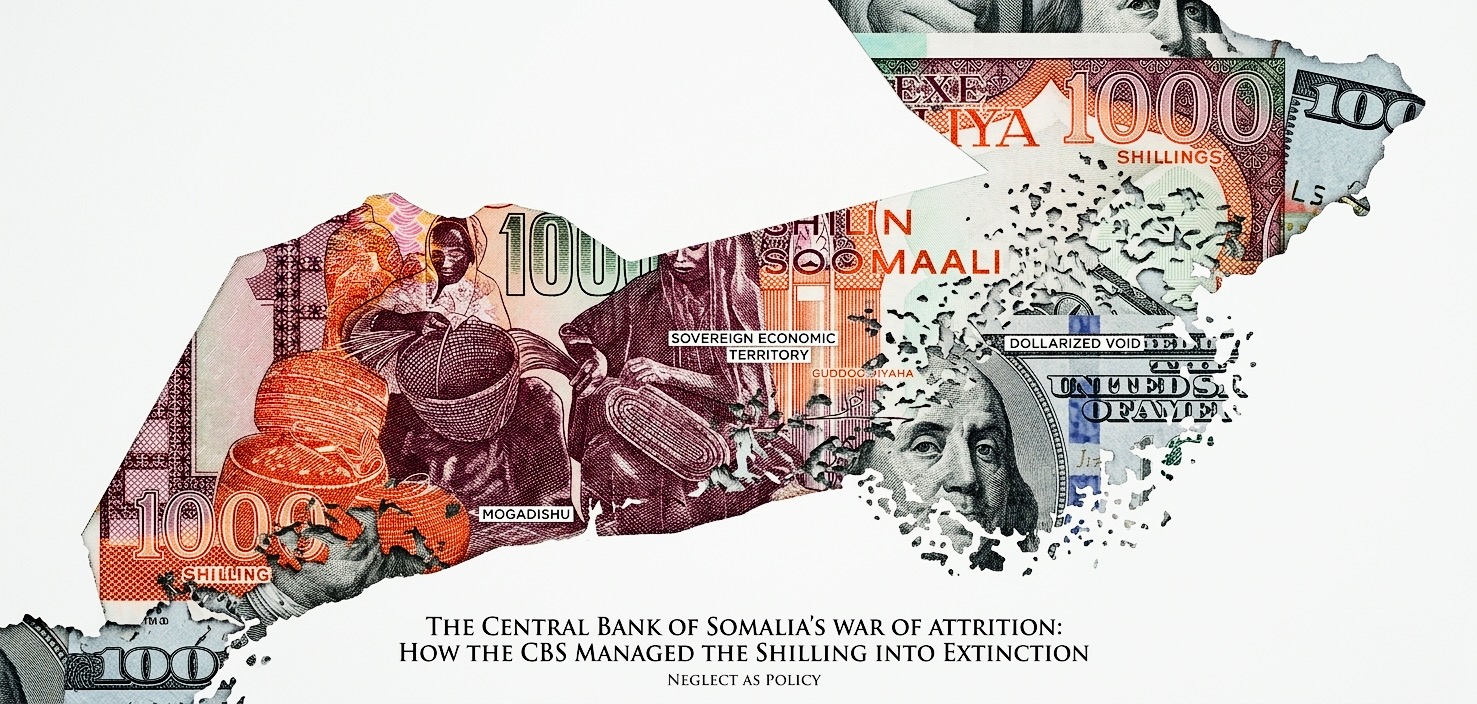
That failure is now visible on the ground. Markets in Mogadishu were the last hold and now they also started rejecting the shilling outright. Merchants no longer accept it, citing the physical decay of notes that have been in circulation for decades. Public transport operators, once the last consistent users of the currency, are abandoning it in favor of mobile payments which is US dollars.
This is not a temporary disruption. It is the terminal phase of a currency collapse.
The CBS has justified inaction through caution. International institutions have urged institutional readiness strong regulatory frameworks, anti-money laundering safeguards, and credible distribution systems before any new currency is introduced. These concerns are legitimate.
Caution has become an alibi
A persistent and unexplained issue is the status of previously printed Somali shilling notes. In 2021, former governor Abdisalam Omer Hadliye stated that banknotes worth $49 million, printed in 2011, were being stored in Sudan. Since then, there has been no clear public accounting of their condition or whereabouts. Reports and circulating footage during the conflict in Khartoum have only deepened uncertainty.
If these notes remain usable, their absence raises questions. If they do not, the lack of disclosure raises even more. In either case, silence is not a policy.
The estimated cost of reintroducing the shilling around $100 million is repeatedly cited as a constraint. Yet Somalia has mobilized far greater resources for other priorities. The issue is not capacity alone; it is the absence of urgency and execution.
the consequences are structural.
In a fully dollarized economy, Somalia forfeits seigniorage the revenue generated from issuing its own currency. That value flows outward. More importantly, the state relinquishes a core instrument of economic control. Monetary policy, in any meaningful sense, becomes impossible. What has emerged in its place is not a coherent alternative, but an unmanaged system.
Somalia today is often described as a digital success story. Mobile money platforms dominate daily transactions, and in many respects the country functions as a cashless economy. But this system did not emerge from deliberate strategy. It emerged in the absence of one.
The shift toward digital, dollar-denominated payments has introduced new vulnerabilities. It excludes those without consistent access to mobile services. It ties the economy to external currencies and private platforms. And it leaves the state with limited oversight over the very system through which most transactions now occur.
The result is a paradox: a central bank without a currency, presiding over an economy it does not fully control.
Other post-conflict states have faced similar constraints and acted decisively. Iraq replaced its currency within months of regime change in 2003, Syria in 2026, despite years of conflict, managed to replace the Syrian pound under extreme conditions. In both cases, the state understood that currency is not just a technical instrument it is a symbol of authority and sovereignty.
Somalia has taken the opposite path
The continued delay in reintroducing the shilling is no longer neutral. It is a policy choice. Whether intentional or not, the outcome is the same: the gradual elimination of the national currency without a formal decision to replace it.
That responsibility rests with the institution mandated to prevent exactly this outcome.
The Central Bank of Somalia was tasked not only with rebuilding monetary authority, but with restoring confidence in the currency itself. On both fronts, it has failed to act with the urgency the situation demands.
If current trends continue, the Somali shilling will not be reformed. It will simply vanish phased out not through strategy, but through neglect.
And once it is gone, restoring it will be far more difficult than preserving it ever was. This is no longer about technical readiness or financial constraints. It is about institutional will. The Somali shilling is not collapsing on its own. It is being allowed to collapse.
And in that failure, the cost is not just monetary it is sovereign.