 xuseen dacwo
 Ethiopia’s political crisis is no longer temporary instability. It is becoming a governing system
Ethiopia still speaks in the language of regional power. That may be the country’s most important political instinct and increasingly, its most revealing contradiction.
The state continues to present itself as the indispensable anchor of the Horn of Africa: a demographic giant, a military power, a diplomatic center, and a civilization-sized state whose stability is treated as synonymous with regional order itself. Foreign delegations continue arriving in Addis Ababa. Strategic partnerships continue expanding. International actors continue speaking in the familiar vocabulary of reform, integration, security cooperation, and economic modernization.
Yet beneath this language of continuity lies a more uncomfortable reality: Ethiopia increasingly appears less like a consolidated regional power than an externally stabilized state struggling to contain unresolved internal fragmentation.
This is larger than civil conflict. It reflects a deeper regional paradox: the more internally strained Ethiopia becomes, the more determined external powers appear to preserve the state intact, not necessarily because its political contradictions have been resolved, but because the consequences of disorder are viewed as too dangerous to risk.
For much of the past two decades, Ethiopia was viewed as one of Africa’s essential strategic pillars. Its size, geography, diplomatic reach, and security role gave it unusual geopolitical importance. The country sat at the intersection of nearly every major fault line shaping the region: the Nile dispute, Red Sea security, migration corridors, counterterrorism operations, Gulf competition, and the fragile balance between Sudan, Somalia, Eritrea, and the wider Horn.
But scale and strategic relevance do not automatically produce cohesion. In some cases, they merely delay the recognition of political exhaustion.
Where many outside observers continue to view Ethiopia primarily as a rising regional power temporarily disrupted by instability, the deeper reality may be the reverse: a politically fragmented state whose geopolitical importance has compelled the international system to continuously stabilize it faster than it can internally consolidate itself.
The distinction between those two interpretations is enormous.
History shows many examples of states that remained outwardly formidable long after internal cohesion began weakening. Late imperial systems often preserve the appearance of authority even as the mechanisms holding them together become increasingly dependent on emergency management, negotiated containment, and external reassurance. The symbolism of power survives longer than political confidence itself.
Ethiopia now exhibits elements of that pattern.
The postwar settlement in Tigray remains fragile enough that political disputes still carry the shadow of renewed conflict. Oromia continues absorbing federal attention and military resources. Amhara remains heavily militarized. Ethnic polarization has not disappeared; in many ways, it has hardened. The federal center continues speaking in the language of authority while multiple regions continue behaving as though authority itself remains conditional and contested.
This is the deeper danger of prolonged internal fragmentation: eventually crisis management becomes the governing model.
A state can survive in such conditions for years, even decades. It can retain ministries, embassies, elections, summits, development programs, and international legitimacy. But internally, governance increasingly shifts from durable settlement toward continuous stabilization. Political order becomes reactive rather than cohesive.
That appears to be Ethiopia’s current condition.
This helps explain why foreign engagement with Addis Ababa has become simultaneously more cautious and more persistent. Ethiopia is now treated less as a fully consolidated regional power than as a strategically indispensable state whose destabilization would carry consequences extending far beyond its borders.
The concern is understandable. A severe Ethiopian collapse would likely destabilize nearly every surrounding theater simultaneously: Sudan’s fragile equilibrium, Somalia’s security environment, Red Sea competition, migration flows, Nile tensions, and broader regional trade systems. Few states in Africa possess such concentrated geopolitical gravity.
Yet external stabilization carries its own risks.
When international actors become deeply invested in preserving the continuity of a state regardless of unresolved political contradictions underneath it, they may unintentionally prolong the very instability they hope to contain. Financial assistance, diplomatic normalization, security partnerships, and strategic accommodation can create the appearance of continuity without necessarily producing deeper cohesion.
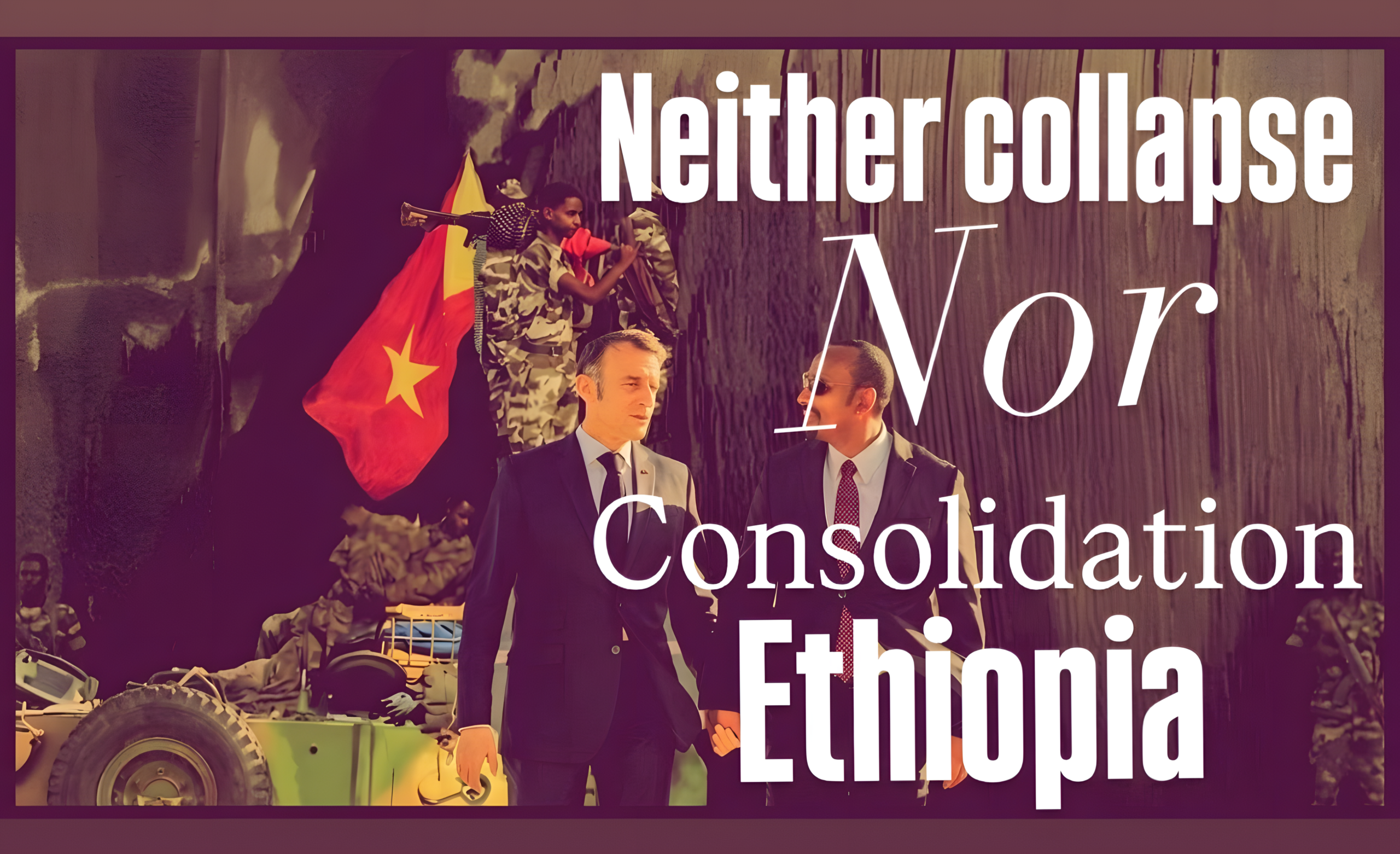
The result is a dangerous political middle ground: neither collapse nor consolidation.
This contradiction increasingly shapes Ethiopian behavior beyond its borders as well. States experiencing prolonged internal strain sometimes attempt to compensate through external geopolitical ambition. The search for sea access, increasingly assertive regional positioning, and involvement in neighboring political disputes cannot be explained through economic logic alone. They also reflect the pressures confronting a large state attempting to preserve strategic stature while internally managing widening fragmentation.
The danger is not simply conflict. It is the normalization of permanent emergency as a governing system.
A country operating under continuous political strain eventually begins treating stabilization itself as success. Temporary calm replaces long-term settlement. Crisis containment replaces institutional trust. Strategic ambition begins exceeding administrative cohesion.
And over time, the distinction between resilience and exhaustion becomes increasingly difficult to measure.
Of course, Ethiopia remains too historically significant, too populous to simply disappear into fragmentation. Multinational states throughout history have survived periods of severe internal crisis before eventually renegotiating political equilibrium. The future is not predetermined.
But neither is cohesion inevitable.
The unresolved question is whether Ethiopia can still transform imperial-scale statehood into durable political settlement or whether the country is gradually entering a condition in which external stabilization substitutes for internal consolidation indefinitely.
That may ultimately become the defining geopolitical question of the Horn. Because history suggests that states governed through permanent emergency rarely collapse all at once. More often, they drift into prolonged exhaustion, preserving the appearance of continuity even as the structures beneath them steadily weaken.