
 amiin ahmed
 A Design Problem, Not a Capacity Problem
The primary failure of Somali diplomacy is not a lack of ambition or resources; it is a failure of policy design. At its core lies a structural misalignment between stated objectives and operational incentives.
On paper, Somalia’s Foreign Service exists to advance national interests negotiating maritime boundaries, structuring security partnerships, and attracting investment. In practice, it functions as a domestic allocation mechanism, distributing diplomatic posts as political rents to maintain clan equilibrium.
From a policy engineering perspective, this is not dysfunction. It is a system producing exactly what it is designed to produce. The objective function is domestic stability, not external influence. Diplomatic performance is therefore irrelevant to the system’s internal logic.
Incentives Define Outcomes
Policy design theory begins with a simple premise: actors respond to incentives, not intentions. In Somalia’s diplomatic system, the incentive structure is clear appointments satisfy political balancing, not strategic output.
The result is predictable. The purpose of an appointment is fulfilled at the moment it is made. What follows negotiations, partnerships, or economic engagement has no bearing on the system’s internal rewards.
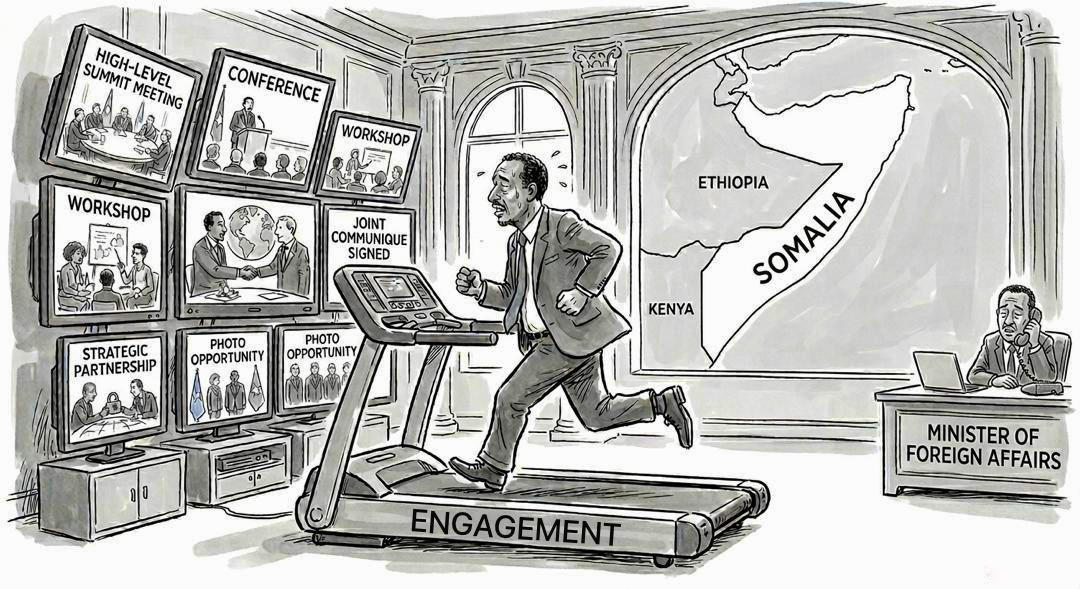
In this configuration, diplomacy becomes symbolic rather than instrumental. Activity is visible, but outcomes are incidental.
Absence of Feedback Loops
A second design failure is the absence of feedback mechanisms. Effective systems incorporate measurement, evaluation, and correction. Somali diplomacy does not.
There is no formal process to assess the return on investment of embassies. Missions are not evaluated against measurable outputs such as trade agreements concluded, policy influence achieved, or alignment secured in multilateral forums. Instead, performance is assessed informally through domestic political satisfaction, revenue from consular services, and access to funds from donor conferences.
From an engineering standpoint, this creates a closed system without feedback. Without measurement, there is no learning. Without learning, there is no adaptation. The system becomes path-dependent, repeating low-yield behaviors regardless of outcome.
The Amateurism Equilibrium
Given these incentives, the system settles into what can be described as an amateurism equilibrium. Professional expertise is neither required nor rewarded.
Diplomacy, however, is a high-signal profession. It requires the ability to detect early shifts in alliances, economic flows, and security dynamics. In the absence of trained personnel, actors substitute, substance with optics meetings, ceremonies, and diplomatic visibility.
These outputs create the appearance of engagement but do not translate into influence. The system optimizes for signaling activity, not achieving results.
No Institutional Memory, No Accumulation
A well-designed institution accumulates knowledge over time. Somalia’s diplomatic system does not.
Because appointments are clan allocated and not embedded in a professional cadre, knowledge remains personalized rather than institutionalized. Relationships, insights, and experience exit with each appointee.
In policy design terms, the system lacks memory storage. It resets rather than compounds. Each political cycle effectively restarts foreign policy from baseline conditions.
Formality Doctrine
If the problem is design, the solution must also be design. Incremental fixes training programs or better appointments cannot correct structurally misaligned incentives.
A redesigned system would rest on three engineering principles:
Strategic allocation of resources. Diplomatic presence should be treated as a constrained asset. Embassies must be evaluated based on measurable strategic value economic, security, or geopolitical. Low-yield missions should be consolidated into fewer, higher-capacity nodes.
Separation of political and operational layers. While ambassadorial appointments may continue to reflect political realities, operational competence must be institutionally insulated. Missions should be anchored by a protected cadre of career diplomats recruited through standardized, merit-based systems.
Performance oversight should be delegated to a parliamentary committee with removal authority, but no role in appointment preserving accountability without politicizing recruitment. This creates an expertise firewall preserving institutional continuity regardless of political turnover.
Embedded feedback mechanisms. Every mission must operate under clear, measurable performance indicators: agreements facilitated, investments secured, policy outcomes influenced. Evaluation must be systematic, not informal.
Without feedback, systems stagnate. With feedback, they adapt.
The Political Economy Constraint
No policy redesign exists in a vacuum. The current system persists because it serves a function: it stabilizes domestic politics.
From a design perspective, the ceremonial embassy is not a failure it is an equilibrium outcome. Reform requires shifting the system’s payoff structure so that external performance becomes politically valuable.
This will not occur through analysis alone. It will occur when the cost of diplomatic underperformance becomes politically salient through lost negotiations, reduced security leverage, or foregone economic opportunities.
A System at an Inflection Point
Systems governed by misaligned incentives do not remain static. They either adapt or degrade.
Somali diplomacy is approaching that inflection point. The constraints of the current design are becoming more visible in an increasingly competitive geopolitical environment.
The question is no longer whether reform is necessary. It is whether policymakers are willing to redesign the system before its inefficiencies become locked in.
Conclusion
Diplomacy does not underperform because of weak individuals or insufficient training. It underperforms because it is governed by a design that rewards political allocation over strategic output.
It produces domestic equilibrium, not international leverage.
The implication is straightforward. As long as the underlying incentive structure remains unchanged, no amount of capacity-building, external support, or rhetorical reform will produce different outcomes. Systems do not behave according to intent; they behave according to design.
The choice, therefore, is not whether to improve diplomacy, but whether to redesign the system that produces it.