
 xuseen dacwo
 Diplomatic Inertia and Missed Global Opportunities
Somalia’s external engagement remains confined to a narrow and predictable circle. Relations with Western partners are still largely defined by aid dependency, while Gulf States and regional actors dominate the strategic landscape. What is harder to justify is the absence of any deliberate outreach to emerging powers that are reshaping global trade and political alignments. Countries such as Brazil, Mexico, Indonesia, South Africa and Malaysia are not peripheral actors they are central to the evolving international order. Somalia’s failure to engage them is not a minor oversight; it reflects a deeper pattern of strategic neglect.
This neglect persists despite clear incentives for change. Somalia possesses one of Africa’s longest coastlines, vast untapped fisheries, and a maritime position that links the Red Sea to the Indian Ocean. These are not abstract advantages they are strategic assets. Yet they remain diplomatically underutilized. Somali embassies, in too many cases, function as ceremonial outposts rather than engines of economic and political engagement.
The familiar defense limited capacity no longer holds. Effective diplomacy is not about being everywhere; it is about being deliberate. Somalia has instead defaulted to passivity, reacting to external agendas rather than shaping its own.
This passivity becomes most dangerous when Somalia’s strategic space is actively being shaped by external actors.
Recent disclosures from the United States Department of Justice indicate that Somaliland appeared in discussions within networks linked to Jeffrey Epstein not merely as a commercial prospect, but as a political project with possible pathways toward recognition. Correspondence reportedly included material shared by Sultan Ahmed bin Sulayem regarding Somaliland’s status.
Taken in isolation, such exchanges could be dismissed as informal or speculative. But they point to a broader pattern. Investigative reporting has previously documented how figures such as former Israeli prime minister Ehud Barak and Epstein leveraged insecurity in Nigeria to promote surveillance technologies, using security access as an entry point into infrastructure and energy sectors. The model is consistent: access first, influence later.
Seen through this lens, the expanding role of DP World aligned with the strategic interests of the United Arab Emirates extends beyond port development. It reflects a wider geopolitical approach in which infrastructure investments translate into strategic leverage, and commercial presence gradually evolves into political weight. Similar dynamics are visible elsewhere in the region, including in Sudan, where the UAE has been widely reported to maintain ties with the Rapid Support Forces, despite official denials.
Somalia has already encountered echoes of this dynamic. Prior to the federal government’s decision to curtail aspects of UAE military and operational presence, tensions over security arrangements with subnational actors highlighted concerns that foreign-backed partnerships could evolve into parallel channels of influence potentially bypassing federal authority.
Within this broader environment, regional realignments have added another layer of pressure. Some analysts interpret the policies of Benjamin Netanyahu, particularly in the context of the Abraham Accords, as part of a wider effort to expand diplomatic normalization. Somalia’s refusal to engage has, in this reading, coincided with increased interest in alternative local actors, including recognizing northern secessionist entities. Whether or not one accepts this interpretation, the convergence of diplomatic pressure, regional alliances, and subnational engagement is difficult to ignore.
Meanwhile, the federal government’s own initiatives remain fragmented. Engagements such as the recent outreach to West Virginia on critical minerals signal ambition, but without a coherent global strategy, such efforts risk becoming isolated gestures rather than components of a broader economic diplomacy framework.
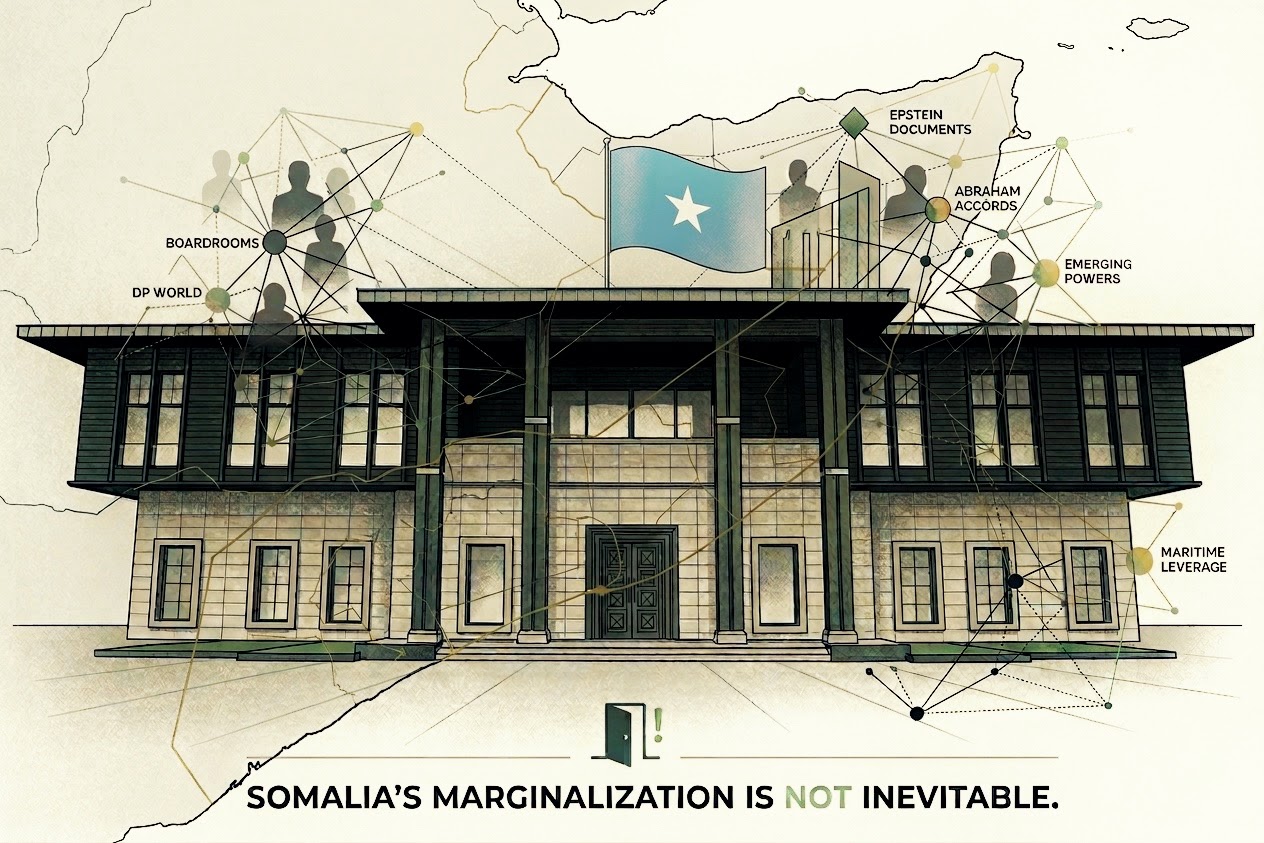
This is the core problem: Somalia’s sovereignty is increasingly shaped in boardrooms, private correspondence, and strategic investments while the state itself remains poorly positioned to respond.. Foreign policy has been reduced to crisis management and relationship maintenance, rather than advancing a deliberate, outcome driven strategy.
The consequences are clear. A reactive posture entrenches dependency, weakens negotiating leverage, and exposes Somalia to shifting geopolitical interests. In an increasingly multipolar world, this is not just inefficient it is dangerous.
More fundamentally, it reflects a failure of political imagination. Foreign policy is not about maintaining presence; it is about projecting purpose. It requires leadership capable of positioning Somalia within emerging global networks, not merely responding to external pressures. That leadership is currently absent.
The Ministry of Foreign Affairs must be reoriented toward proactive, strategic engagement with clear priorities and measurable outcomes. Embassies must deliver results, not symbolism. Partnerships must be pursued deliberately, not incidentally.
But bureaucratic reform alone will not suffice. This requires political will at the highest level. The next administration must decide whether Somalia will remain reactive or become strategic. The Ministry must function as an instrument of national positioning, not merely external management.
Somalia’s marginalization is not inevitable; it is a policy of choice. By retreating into comfort zones and allowing external boardrooms to define the national terrain, the state is effectively subcontracting its future. In a world defined by aggressive networks of influence, diplomatic absence is not a neutral stance. It is a quiet surrender of the state itself.