
 xuseen dacwo
 The Red Sea Checkerboard
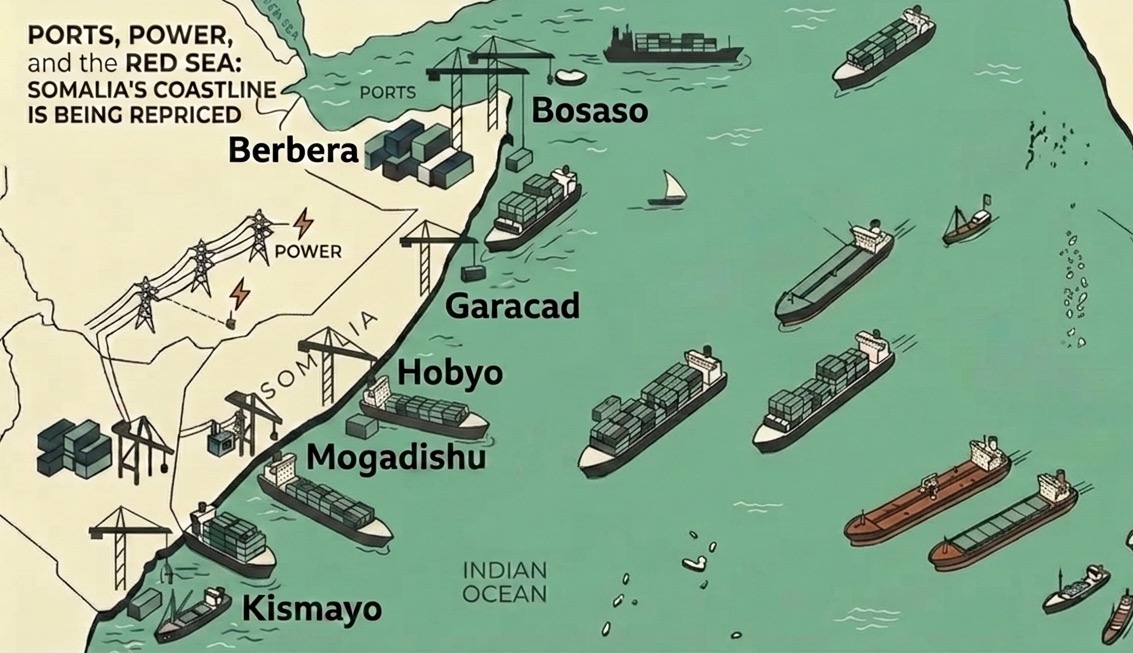
From the Gulf of Aden to the Indian Ocean, external actors are no longer debating whether Somalia matters; they are positioning for when it decisively does. Ports, logistics corridors, and maritime security arrangements have become central tools for projecting influence across the Red Sea corridor, especially as disruptions ripple outward from chokepoints like the Strait of Hormuz, where tensions and shipping delays expose the fragility of global trade routes. In this environment, infrastructure is not neutral; it is strategic.
Framing port development in Somalia as either economic or geopolitical misses the point. The two are inseparable. Control over infrastructure translates into influence over trade flows, security arrangements, and ultimately political leverage particularly when alternative routes and fallback corridors become more valuable during regional disruptions.
Somalia’s coastline sits along one of the world’s most important maritime arteries, linking the Red Sea to the wider Indian Ocean. That geography has not changed. What has changed is the urgency and structure of external engagement around it, as shifting risks in nearby chokepoints push actors to secure position, access, and influence along this corridor.
Infrastructure as Leverage
For the Federal Government of Somalia, port development is inseparable from authority. Expanding capacity in Mogadishu and along this is not just about trade it is an effort to channel economic flows through national institutions and assert that sovereignty is exercised at the center.
That outcome is far from assured. Somalia’s federal model remains contested, and economic gains do not automatically yield political control. But the underlying logic is clear: those who control the ports set the terms of external engagement and, by extension, shape the state itself.
Turkey exemplifies an integrated approach, linking infrastructure, security, and energy into a single framework. Its footprint spanning port management, military training, and offshore exploration anchors it within the federal state. This is not just an investment; it is an embedded influence that reinforces central institutions while binding them to an external partner.
The United Arab Emirates, by contrast, operates through a more decentralized model. Its engagement in Berbera and Bosaso routes power through subnational actors, where infrastructure can become a source of authority that at times operates at a distance from Mogadishu.
These approaches carry distinct political consequences, one consolidates the center, the other works within and can deepen fragmentation. In both, sovereignty endures in law, but in practice it is shared, shaped, and constrained from the outside.
The Ethiopian Variable
No analysis of Somalia’s coastline is complete without confronting a simple reality: in Somalia, ports are power.
For Ethiopia, a landlocked state under mounting demographic and economic pressure, access to the sea is not optional it is strategic. Constraints elsewhere have pushed Addis Ababa to look more intently toward Somalia’s coastline, where opportunity is shaped as much by governance gaps as by geography. This has elevated Somali ports from commercial assets into instruments of regional bargaining.
For Somalia, the implications are significant. Infrastructure partnerships offer clear economic upside, but without a coherent national framework, they also risk diffusing control over critical assets. In this environment, ports are no longer just gateways for trade they are levers through which influence is negotiated and power quietly rebalanced.
Opportunity and Constraint
The economic case for port development is straightforward. Improved logistics reduce import costs, expand exports, and generate employment beyond the port itself. For Somalia, this is not marginal it is foundational. Transport costs shape food prices, business margins, and household stability.
Over time, a functioning maritime economy linking ports, fisheries, and trade corridors could support a broader shift away from a narrow, import-dependent model. But the constraints are equally significant.
Infrastructure built through external partnerships often carries embedded influence from financing terms to operational control and security arrangements. In a fragmented political system, this can translate into uneven authority across regions.
The deeper risk is not external involvement in itself. It is the emergence of parallel systems: ports aligned with different external actors, operating under different political and economic logics. Over time, this risks reinforcing the fragmentation Somalia is attempting to overcome.
Repricing the Coastline
What is unfolding along Somalia’s coastline is, at its core, a strategic revaluation. Long discounted due to risk and underinvestment, it is now being reassessed for its actual weight in regional and global systems. The risks have not disappeared only the calculations have changed. This shift does not automatically benefit Somalia. It creates leverage, but only if that leverage is consolidated.
The central challenge is alignment. Economic development, security arrangements, and political authority must move in the same direction. Without that alignment, infrastructure will generate activity without consolidation growth without control. There is no neutral port in this environment. Every project embeds relationships and constraints beyond trade. The task is not to resist engagement, but to structure it. Otherwise, Somalia’s future will not be determined through strategy, but negotiated incrementally port by port, deal by deal.