 xuseen dacwo
 what appears as coop is in fact coordinated
The persistence of instability in Somalia is not simply a byproduct of internal weakness. It is also a condition that neighboring states particularly Kenya and Ethiopia have learned to manage and, at times, strategically sustain. In effect, Somalia operates within a framework of “controlled instability”, a political equilibrium that avoids total collapse but prevents the consolidation of a strong central state.
This dynamic is rooted in the structure of Somalia’s political system. The Federal Government of Somalia (FGS) remains constrained by ongoing disputes with Federal Member States (FMS), limited fiscal capacity, and fragmented security authority. Within this environment, political behavior is shaped less by institutional rules than by financial incentives. The “political marketplace” framework provides a useful lens, power is maintained through the distribution of resources what are often described as political budgets to secure loyalty from clan leaders, militia actors, and political elites.
In such a system, decision-making is transactional. Policies are not consistently evaluated on long-term national interest, but on their immediate political returns. This creates predictable entry points for external influence.
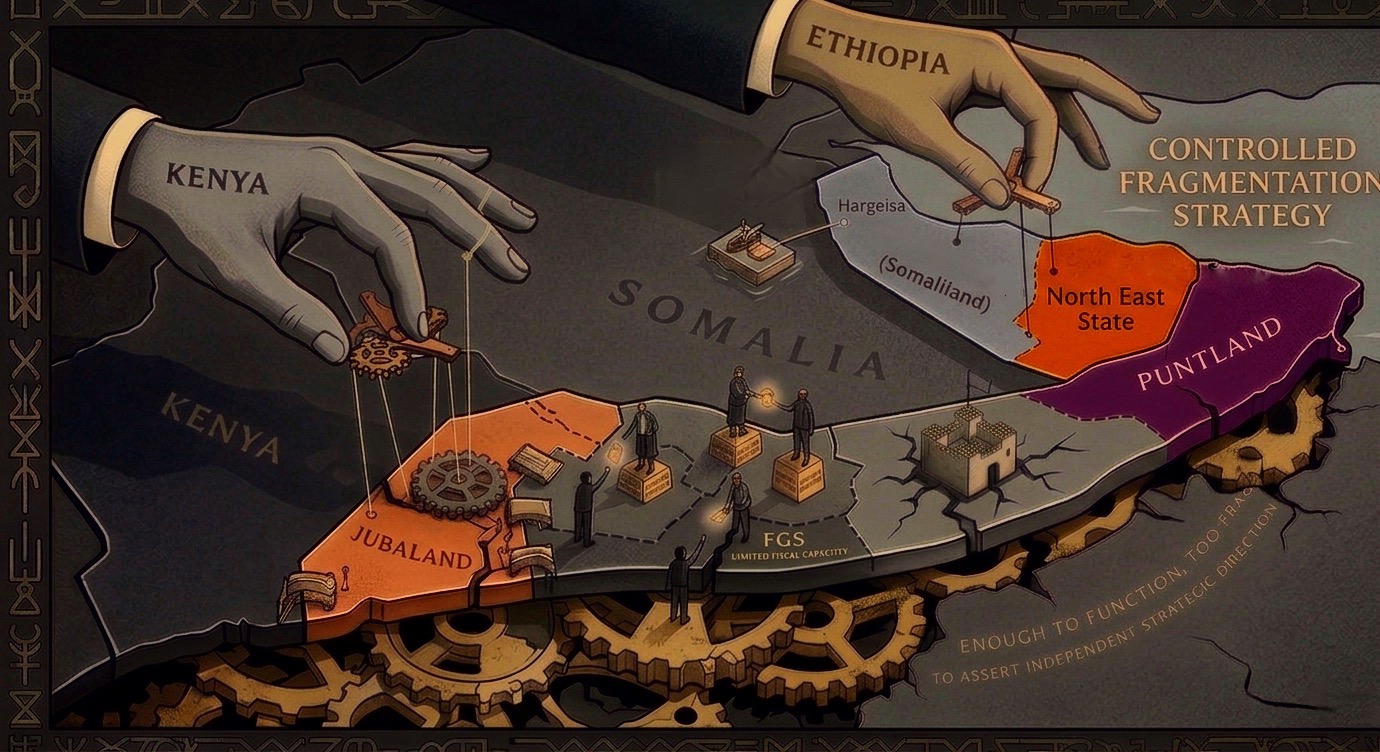
Kenya and Ethiopia have adapted to this environment with a strategy that does not seek outright domination, but rather calibrated engagement within fragmentation. A fully centralized Somali state with unified security forces and coherent foreign policy would limit their room for maneuver. By contrast, a decentralized and internally contested Somalia allows both countries to maintain influence through regional relationships, security partnerships, and political alignment with subnational actors.
This approach is visible in the interaction between external actors and federal dynamics. Regional administrations such as Puntland and Jubaland and Somaliland have repeatedly resisted aspects of constitutional consolidation and federal authority. These positions are not formed in isolation. They are reinforced through diplomatic engagement, security cooperation, and, in the case of Jubaland, direct military alignment with Kenya.
The result is not disorder in the absolute sense, but a managed equilibrium. Somalia remains functional enough to engage internationally and participate in regional institutions, yet sufficiently fragmented to prevent the emergence of a unified political and security architecture. This is the essence of the “good enough” approach: stability is maintained at a level that serves external strategic interests without enabling full state consolidation.
Historical precedent reinforces this pattern
Ethiopia’s 2006 intervention to remove the Union of Islamic Courts (UIC) achieved its immediate objective but generated second-order effects that reshaped Somalia’s security landscape. The collapse of the UIC created the conditions for Al-Shabaab to emerge as a durable insurgent force, leveraging nationalist narratives against foreign presence. The intervention demonstrated that while external force could disrupt political actors in Somalia, it could not produce stable outcomes without internal legitimacy.
This strategy of calibrated engagement reached a modern zenith with the 2024 Ethiopia-Somaliland MoU. By bypassing the FGS to negotiate directly for maritime access, Addis Ababa demonstrated that it views Somalia’s internal fragmentation not as a hurdle to be overcome, but as a strategic frontier to be utilized. The deal effectively ‘prices’ Somali sovereignty, offering recognition to a subnational actor in exchange for national strategic assets a move that anchors Somalia’s disunity into the permanent maritime and economic architecture of the Horn.
Kenya’s 2011 intervention followed a different but related trajectory. Operation “Linda Nchi”, initially framed as a response to cross-border insecurity, evolved into a longer-term political and security presence in southern Somalia. Nairobi’s support for the Jubaland administration under Ahmed Madobe former warlord and al Shabab leader established a buffer zone that aligned with Kenyan security priorities. However, it also entrenched a semi-autonomous regional structure that operates with a degree of independence from the FGS, reinforcing Somalia’s internal fragmentation.
These approaches are not ad hoc. They reflect longer strategic trajectories.
For Ethiopia, the memory of the Ogaden War continues to shape its security doctrine. The re-emergence of a strong, centralized Somali state is viewed through the lens of potential territorial and political risk. Preventing that outcome has, at times, translated into support for decentralized structures and regional actors within Somalia.
For Kenya, the legacy of the Northern Frontier District (NFD) dispute and subsequent insurgency has embedded a securitized approach to Somali politics. State policy has consistently prioritized buffer zones and cross-border control mechanisms, which align more easily with a fragmented Somali political order than with a consolidated one.
None of this suggests that Somalia’s instability is externally engineered in a simplistic sense. Internal fragmentation, elite competition, and weak institutions remain the primary drivers. However, these internal conditions have created a system in which external actors can operate with leverage, reinforcing dynamics that align with their own strategic interests.
The policy implication is direct: as long as Somalia’s political system remains highly monetized and institutionally fragmented, external influence will continue to find effective entry points. Sovereignty, in this context, is not only a matter of territorial control but of reducing the transactional nature of political authority.
A shift is therefore required at the structural level. This includes strengthening fiscal transparency to limit the use of political budgets, enforcing constitutional clarity between the FGS and FMS, and consolidating security forces under a unified national command. Without these changes, Somalia risks remaining in a state of managed fragility stable enough to function, but too fragmented to assert independent strategic direction. Until Somalia’s political authority is de-transactionalized, sovereignty will remain negotiable internally contested and externally leveraged.